Balinese Design Language Afloat: Carving, Stone and Textile at Sea
Updated: August 2026
Bali has a design language the world already recognises — carved timber, volcanic stone textures, hand-woven textiles, the calm geometry of pavilion architecture — and yacht owners increasingly ask for it afloat. The translation works beautifully when it is a translation: motifs re-engineered in marine materials, textures achieved at sea-going weights, textiles specified for salt and sun. Where the language must bend, marine practicality wins; where it can speak, nothing else feels like it.
What the language is made of
The island’s aesthetic rests on a few strong elements. Carving: relief patterns and figurative work from a living temple-craft tradition. Stone: the greys and creams of volcanic andesite and limestone that give Balinese architecture its grounded calm. Textile: ikat and songket weaving, natural fibres, layered neutrals with disciplined accents. And composition: the pavilion logic of open sight lines, framed views and shaded transitions between inside and out — a logic that happens to be exactly what a good deck plan wants.
A yacht brief in this language is not themed decoration; it is a coherent palette owners choose because their Bali houses taught them to love it — very often the same owners profiled in our piece on the villa-owner buyer.
Carving and timber: the direct translation
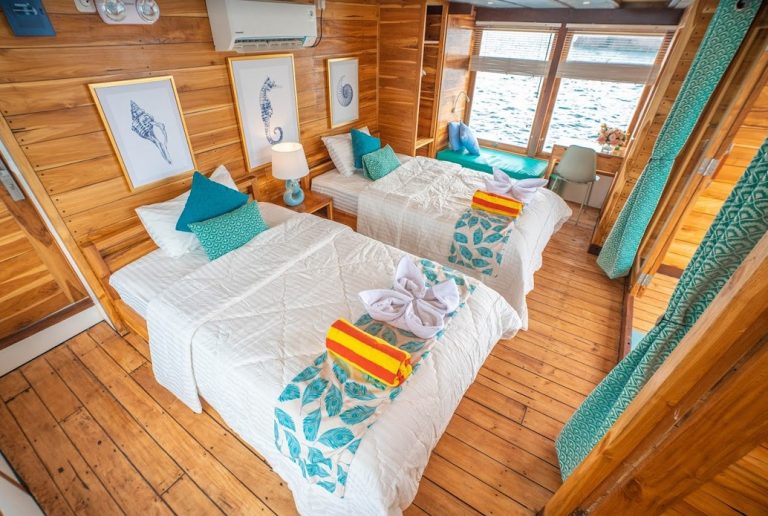
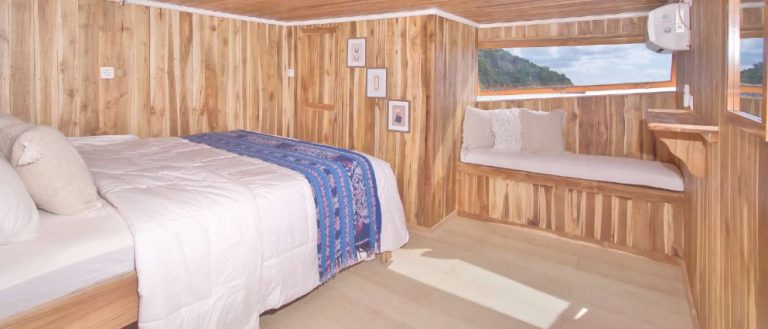
Timber is where the language crosses to sea most directly. Carved panels, screens and mouldings translate well when the engineering underneath is marine: stable substrates instead of heavy solid slabs, finishes built for UV and humidity, and restraint in placement so ornament reads as signature rather than surface. A carved companionway screen or a repeated motif across cabinet doors carries more presence at sea than a saloon of wall-to-wall relief.
The craft chain for this work — the joinery studios and carving villages inland — is the subject of its own guide, Interior Craftsmen of Bali; the design point is that the tradition adapts because builders adapt it, not because it is simply installed.
Stone and texture: illusion in service of honesty
Real stone is mostly wrong at sea — heavy, brittle, unkind to weight studies — so the language’s stone register is achieved by translation: thin natural veneers on honeycomb cores where a genuine surface earns its kilograms, and high-quality mineral-texture finishes elsewhere. The visual calm survives; the displacement does not notice. Bathrooms, galley splashes and feature bulkheads are the natural homes for the stone note, sized by the same weight discipline as everything else in a specification.
Designers who know both worlds treat this honestly with owners: the goal is the island’s visual temperature, not a geological cargo manifest. Weight-driven decisions like these are exactly why interiors run through the naval architect’s study, as covered in our collaboration guide.
Textiles, light and the pavilion logic
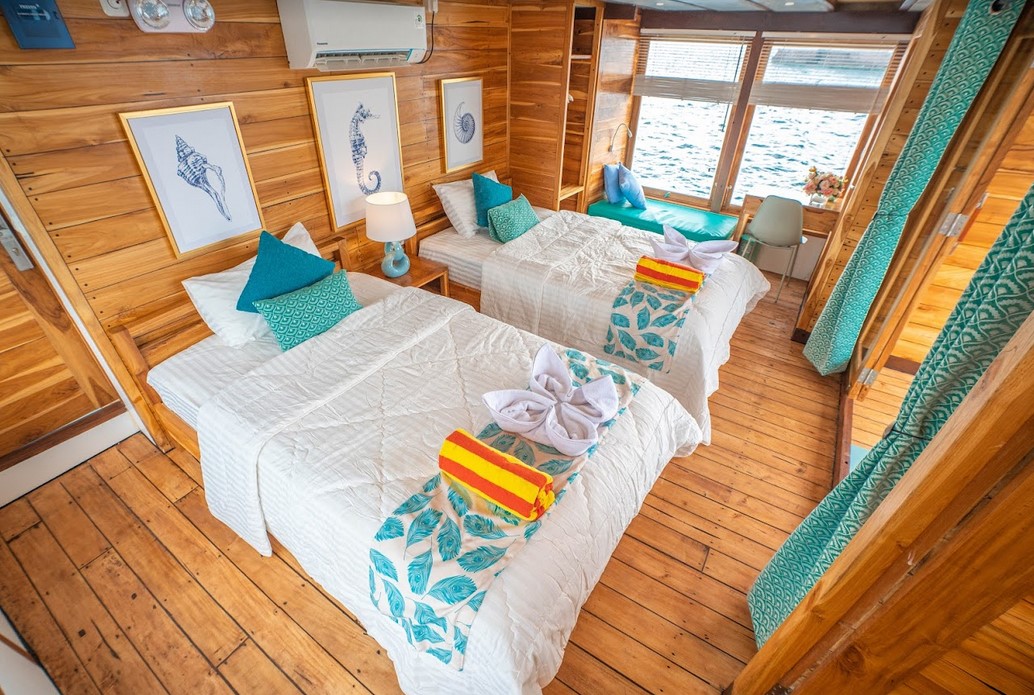
Textiles carry the language’s warmth, and they are the easiest element to specify correctly: marine-grade base fabrics for anything sun-struck, with genuine hand-woven pieces — ikat cushions, runners, wall panels — deployed where cover and care protect them. The colour discipline of Balinese interiors, layered naturals with sparing accent, happens to be ideal for boats, where small spaces punish visual noise.
The deepest translation is compositional. Pavilion architecture’s framed views, shaded thresholds and open flow map naturally onto a yacht’s cockpit-saloon-deck sequence: wide openings, sight lines to water from every seat, shade engineered as structure. A boat designed with that logic feels Balinese before a single motif appears — which is the mark of a language spoken fluently rather than quoted.
Frequently Asked Questions
Does a Balinese interior make a boat heavier?
Not when translated properly — veneers, cored panels and texture finishes deliver the look inside a normal weight budget. Solid stone and slab timber are where briefs go wrong.
Can traditional textiles survive marine use?
Hand-woven pieces live in protected roles while marine-grade fabrics take the sun. The layered look survives; the originals last.
Will carving feel excessive on a modern yacht?
Restraint is the design rule: one or two signature placements read as identity. Full-coverage ornament belongs ashore.
Who designs a Balinese-language interior?
Typically an interior designer fluent in the island’s vocabulary working with the builder’s craft chain — a pairing Bali supports better than anywhere.
Bring the island’s language aboard
If your build should speak Bali, the Bali Yacht Builder desk will connect designers, carvers and the marine engineering that lets the language sail — WhatsApp +62 811-2859-0000 or [email protected].
Keep reading
Yard Life
Small Shipwright Workshops of Bali: Keeping Wooden Skills Alive
Behind Bali's headline yacht projects works a quieter tier: small shipwright workshops — often family crews of a handful of…
Yard Life
Interior Craftsmen of Bali: Joinery Studios Behind the Yachts
The interiors that distinguish Bali-built yachts are made largely off the waterfront, in joinery studios scattered through the island's furniture…

Yard Life
Sea Trials in the Badung Strait: Testing Grounds off Bali
Every boat built in south Bali proves itself in the same water: the Badung Strait, the channel between Bali and…