Bali Yacht Ownership Costs After Handover: Berthing, Crew and Maintenance Budgets
Updated: August 2026
Bali yacht ownership costs after handover run, as an honest planning rule, 8–12% of vessel value per year for crewed boats: berthing at Benoa, crew payroll, insurance, scheduled maintenance and the annual haul-out. Timber vessels sit at the top of that band in the tropics; composites lower. Budgeting these numbers before the build is what keeps ownership a pleasure.
The annual budget, line by line
New owners consistently underestimate not the size of ownership costs but their regularity — the boat spends money every month whether it moves or not. The five recurring lines are berthing or mooring, crew, insurance, planned maintenance, and consumables including fuel for the hours you actually cruise. To these add a sixth that disciplined owners fund from day one: a reserve for the items that arrive on multi-year cycles — rigging, coating renewals, engine mid-life service, electronics refresh. Vessels that skip the reserve do not avoid the costs; they meet them all at once in survey years, which is precisely the pattern our cost guide is built to prevent at the purchase stage.
Honest bands for a crewed vessel based in Bali
| Line item | 15–20m composite | 30–40m timber phinisi |
|---|---|---|
| Berth / mooring, year | USD 6,000–15,000 | USD 12,000–30,000 |
| Crew payroll (4–10 crew) | USD 25,000–60,000 | USD 60,000–150,000 |
| Insurance | 0.8–1.5% of hull value | 1.0–2.0% of hull value |
| Maintenance & haul-out | 3–6% of value | 5–10% of value |
| Fuel & consumables | Usage-driven | Usage-driven |
Bands reflect Indonesian cost structure in 2026 and genuinely favourable crew economics — a full professional crew here costs a fraction of Mediterranean payroll at equal hospitality standards. All figures are planning bands, not quotes; specification and usage move every line.
Timber versus composite in a tropical climate
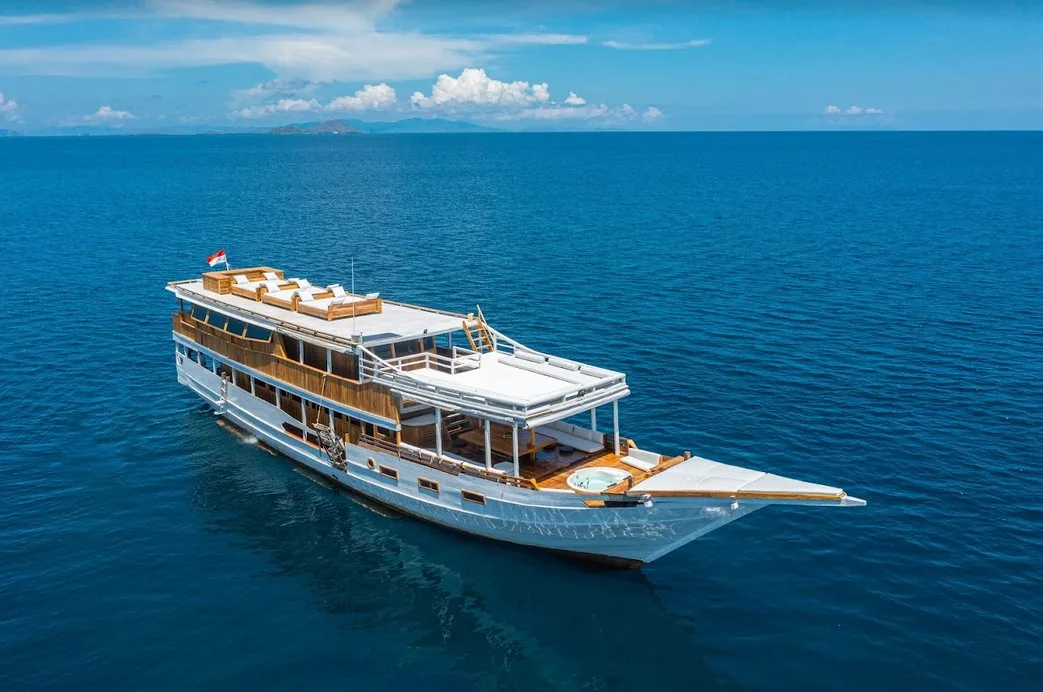
The material decision made at contract echoes through every ownership year. Timber hulls in warm salt water demand vigilant seam care, more frequent slipping — every 10–14 months against 12–18 for composites — and a crew culture of daily washdowns and ventilation. Their reward is character, repairability with local skills, and charter appeal no production boat matches. Composites carry lower routine upkeep but concentrate costs in coating systems and osmosis prevention. Neither is wrong; they are different maintenance temperaments, and the honest comparison belongs in the purchase decision, which is why we put it beside the build paths on the builder comparison hub.
Offsetting costs with charter — the realistic view
Many Bali-based owners place their vessel into managed charter for part of the year, and the arithmetic can genuinely work: a well-marketed expedition yacht in Komodo season can cover most or all of its running costs, with published example returns in structured programs running 6–14% net — never guaranteed, and dependent on vessel, marketing and season length. The sober rule is to buy and budget as if charter income were zero, then treat every chartered week as upside. Owners who reverse that logic — relying on projected weeks to afford the boat — are the unhappy stories of this coastline.
Build the budget before the boat
Our studio issues every build client a ten-year ownership budget alongside the build quote, so the second decade of the decision is as visible as the first. For a personalised budget on a vessel you own or plan to commission: WhatsApp +62 811-2859-0000 or [email protected]. The single largest recurring line — the haul-out — is detailed in antifouling in Bali.
Crew structure: where Bali genuinely changes the numbers
Crew is the line where an Indonesian base most transforms ownership economics, so it deserves its own arithmetic. A crewed 30-metre vessel in the Mediterranean carries payroll that often exceeds every other cost combined; the same vessel based in Bali staffs a captain, engineer, chef and deck-and-service team at a total commonly one-third of European cost — with hospitality standards, it must be said plainly, that guests routinely rate above their Mediterranean experiences. The structural reasons are durable: Indonesia has a deep maritime labour tradition, strong hospitality culture, and crew live at home rather than on expatriate packages. The owner’s responsibilities are equally real: proper employment contracts, certified training kept current, crew insurance, and the fair seasonal bonuses that keep an excellent team for a decade rather than a season. Owners who invest in their crew this way report the compounding benefit nobody prices into a spreadsheet — a boat that is genuinely cared for between owner visits, which over ten tropical years is worth more than any single line in the budget.
Ownership costs — frequently asked questions
How much does it cost to keep a yacht in Bali per year?
Plan 8–12% of vessel value annually for a crewed boat: berthing, crew, insurance, maintenance and haul-out. A 15–20 metre composite cruiser typically lands between USD 60,000 and 150,000 depending on crew size and usage.
Are yacht running costs lower in Indonesia than elsewhere?
Crew and skilled-labour lines are substantially lower than Mediterranean or Caribbean equivalents at equal standards, while imported parts and insurance are broadly similar. Net ownership cost in Bali is usually meaningfully below comparable bases.
Do wooden yachts cost more to maintain than fiberglass?
In the tropics, yes — plan 5–10% of value annually versus 3–6% for composites, driven by more frequent slipping and seam care. The gap narrows on vessels with disciplined crews and unbroken maintenance calendars.
Can charter income cover my yacht’s running costs in Bali?
It can contribute substantially in strong seasons, and structured programs publish example net returns of 6–14% — but income is never guaranteed. Budget ownership at zero charter income and treat chartered weeks as upside.
Keep reading

Cost & Decisions
Pricing a Bali Custom Build: Labour, Materials and the Island Premium
The price of a custom build in Bali is set by four forces: labour (the island's skilled rates are competitive…
Cost & Decisions
Importing Materials Through Benoa: Duties on Build Components
Most of the high-value components in a Bali-built boat — engines, resin systems, rigging, electronics, deck hardware — arrive by…
Cost & Decisions
Indonesian Customs Clearance for Yachts: Import Duty, Export and Temporary Stay
Indonesian customs treats a yacht in one of three ways: an import (duty and taxes due), an export (a new…