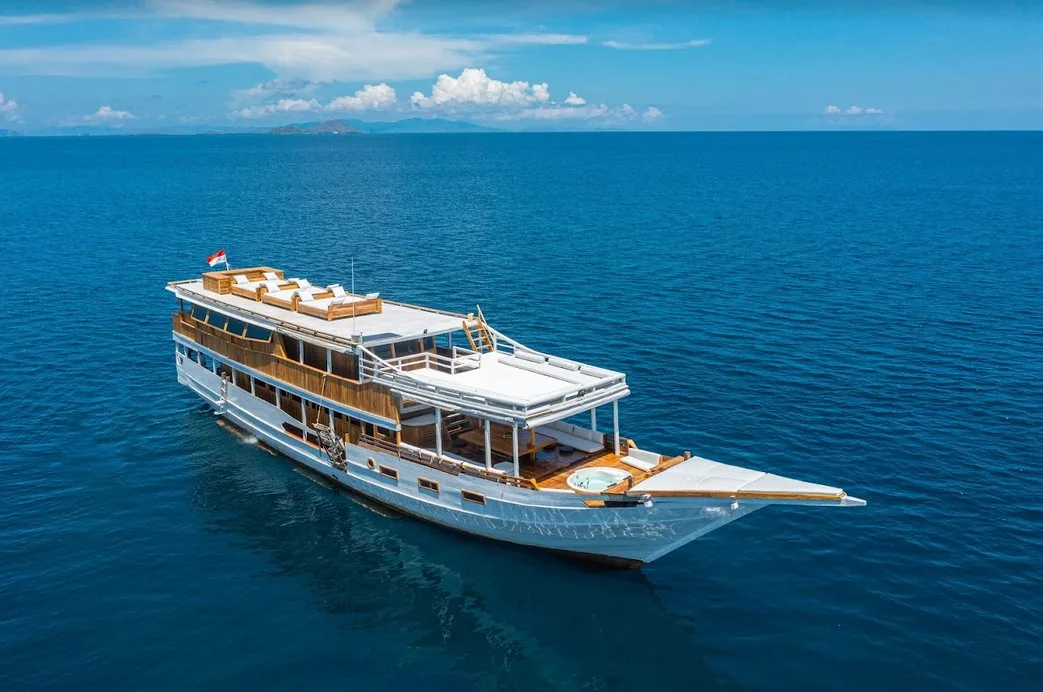

Indonesian Flag Yacht Regulations: Cabotage, SIUPAL and What Owners Must Know

Updated: August 2026
Cabotage: the rule the whole fleet is built around
Indonesian law reserves the carriage of passengers and goods between Indonesian ports for Indonesian-flagged vessels — the same cabotage principle the United States and many maritime nations apply. For the yacht sector the consequence is direct: a charter picking up guests in Labuan Bajo and cruising Komodo is domestic passenger carriage, and the vessel doing it lawfully flies the red and white. This is not a loophole-hunting environment; enforcement attention on the Komodo fleet has grown with the destination’s fame, and the operators who built compliant structures early now enjoy the durable advantage of being unremarkable to inspectors. The build-side implication is equally direct — vessels intended for this trade are designed to Indonesian survey requirements from the keel up, as covered on the design and standards page.
The PT PMA ownership structure
Foreigners do not simply register an Indonesian vessel personally. The working vehicle is a PT PMA — Indonesia’s foreign direct investment company — holding the vessel and the operating licences. In sea transport the foreign shareholding is capped (the commonly applied structure allows up to 49% foreign ownership), so a credible, properly documented Indonesian partner or structured shareholding is part of the design. Beyond ownership percentages, the company must be real: capitalised to requirements, tax-registered, filing annually, employing qualified crew under Indonesian terms. Treating the PT PMA as a living business rather than a filing formality is what keeps licences renewable year after year — and it is the difference visible in due diligence when the vessel eventually sells.
| Layer | Instrument | Covers |
|---|---|---|
| Company | PT PMA licences & tax registration | Legal existence, investment compliance |
| Operator | Right to operate vessels commercially | |
| Vessel | Registry, tonnage, safety certificates | The ship’s own legal identity |
| Operation | Port clearances, area permissions | Each voyage’s lawfulness |
| People | Crew certificates & manning compliance | Qualified operation |
The stack looks bureaucratic listed out; in practice a well-run operator treats it as an annual calendar with known dates and costs, budgeted from day one alongside the build cost plan.
The annual compliance rhythm
Indonesian-flag commercial vessels live on a survey cycle: annual safety survey and certificate renewals, docking survey on the flag’s schedule — which pairs naturally with the tropical antifouling cycle — crew certificate currency, and the company-level filings that keep the SIUPAL in good standing. None of it is exotic; all of it is calendar discipline. The operators who struggle are those treating each renewal as a surprise; the operators who thrive delegate the calendar to a management layer and sail. Our project desk hands over every Indonesian-flag build with that compliance calendar pre-built for its first three years.
Structure first, then sail
If your plan involves Indonesian charter revenue, the structure conversation belongs before the build contract, not after launch — the flag shapes the vessel. We walk owners through cabotage, PT PMA formation and the licence stack with real costs and honest timelines: WhatsApp +62 811-2859-0000 or [email protected]. The registry-choice half of the decision is mapped in offshore vs Indonesian flag registration.
Operating in the marine parks: the extra layer
Vessels working Indonesia’s flagship destinations carry one more compliance layer worth planning for: protected-area rules. Komodo National Park and its peers operate entry permitting, guest fees, mooring and anchoring restrictions and — increasingly — vessel standards expectations, administered alongside the national licence stack rather than within it. For operators this is mostly a bookkeeping matter with two strategic notes. First, the direction of travel is toward higher standards and managed vessel numbers in the premium parks, which structurally favours compliant, certified, professionally run vessels — the regulatory moat rewards exactly the operators who built properly. Second, park compliance is reputational as well as legal: guide licensing, waste discipline and anchoring behaviour are watched by rangers, competitors and guests with cameras, and a vessel’s standing in a small port economy is an asset with real value. Owners entering the trade should budget the permits and fees as ordinary operating cost and treat the standards as a competitive weapon: in a destination the whole world wants to visit, being unambiguously legal is a marketing position.
Indonesian flag rules — frequently asked questions
What is cabotage and how does it affect yacht charter in Indonesia?
Cabotage reserves commercial carriage between Indonesian ports for Indonesian-flagged vessels. Charter that embarks and disembarks paying guests in Indonesia is domestic carriage, so lawful operation requires the national flag under a compliant structure.
Can a foreigner own an Indonesian-flagged yacht?
Through a PT PMA — Indonesia’s foreign-investment company — with foreign shareholding capped in sea transport, commonly structured at up to 49%. The company, not the individual, owns the vessel and holds the operating licences.
What is SIUPAL and does every charter yacht need it?
SIUPAL is the sea transport business licence entitling a company to operate vessels commercially. Commercial yacht operations under the Indonesian flag hold one at the operator level, alongside the vessel’s own registry and safety certificates.
What annual compliance does an Indonesian-flagged yacht face?
Annual safety survey and certificate renewals, scheduled docking surveys, crew certificate currency and company-level licence and tax filings. Run as a pre-built calendar, it is routine; run reactively, it costs seasons.
Keep reading

Cost & Decisions
Pricing a Bali Custom Build: Labour, Materials and the Island Premium
The price of a custom build in Bali is set by four forces: labour (the island's skilled rates are competitive…
Cost & Decisions
Importing Materials Through Benoa: Duties on Build Components
Most of the high-value components in a Bali-built boat — engines, resin systems, rigging, electronics, deck hardware — arrive by…
Cost & Decisions
Indonesian Customs Clearance for Yachts: Import Duty, Export and Temporary Stay
Indonesian customs treats a yacht in one of three ways: an import (duty and taxes due), an export (a new…