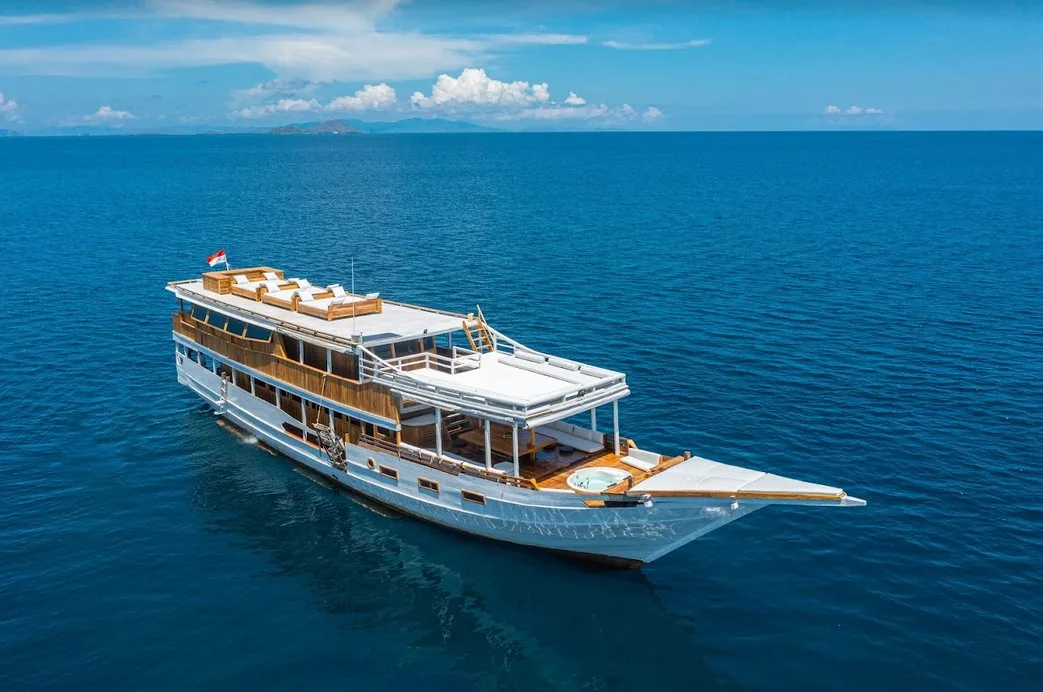

Indonesian Catamaran Naval Architecture: Hull Forms Proven in Archipelago Seas

Updated: August 2026
Indonesian catamaran naval architecture answers a specific exam: short steep strait chop, strong tidal currents, heavy charter payloads and long unsupported distances. The hull forms that pass — generous bridgedeck clearance, honest displacement margins, moderate beam ratios — differ measurably from marina-belt designs drawn for gentler seas.
What archipelago seas actually do to a catamaran
Indonesian waters are not uniformly benign. Between the calm anchorages lie the straits — Badung, Lombok, Sape, and the passes of Komodo — where tide against wind builds short, steep, confused chop unlike open-ocean swell. A catamaran meets this sea state with its bridgedeck: too little clearance and every third wave slams the underside, fatiguing structure and guests alike. Currents running to six knots demand engine reserves and handling authority that brochure cruising speeds ignore. And distances between support facilities reward displacement honesty — a hull with real payload margin carries its water, fuel, dive kit and provisions without sitting on its marks. These are calculable demands, and designing to them is the difference between a boat that works here and one that merely arrived here.
The numbers that matter
| Parameter | Archipelago-proven range | Why it matters |
|---|---|---|
| Bridgedeck clearance | ≥ 5–6% of LOA | Slamming resistance in strait chop |
| Length-to-beam (overall) | ~1.9–2.2 | Stability vs windage and dock reality |
| Hull fineness (L/B per hull) | 9–12 cruising, higher for fast cats | Efficiency at working displacement |
| Payload fraction | 25–35% of displacement | Charter loads without performance collapse |
| Draft | 1.0–1.4 m typical | Reef anchorages, beaching options |
Ranges are design guidance, not dogma — a fast dive cat and a liveaboard sailer sit at different points. The discipline is choosing the point deliberately against the operating profile, which is where the catamaran construction program begins every project.
Charter loads change the mathematics
A private cruising couple loads a catamaran lightly; an Indonesian charter operation does not. Twelve guests, four crew, dive compressors, tenders, a week of provisions and full tanks routinely add eight to twelve tonnes to a 20-metre platform. Designs drawn to look fast at light displacement lose their bridgedeck clearance and trim exactly when revenue is aboard. Archipelago-proven architecture designs at working displacement: waterlines, clearances and stability calculated with the business on board, then verified at inclining. It is the least glamorous decision in the design spiral and the one charter operators thank you for every season — a lesson embedded across the charter boat build program.
Local knowledge, global methods
The productive design teams here pair both worlds: naval architects fluent in modern tools — CFD-checked hull forms, engineered laminates, ISO stability standards — with Indonesian designers, skippers and yard masters who know what Sape Strait does to a bridgedeck in August. Foreign architects bring methodology; local experience brings the exam questions. Our studio structures collaborations exactly this way, with hull forms reviewed against route data before any tooling is cut, coordinated through the nationwide build network.
Design for the seas you will actually cross
If your catamaran will live between Bali and Raja Ampat, design it for those straits from the first sketch. Send us your route ambitions and payload reality: WhatsApp +62 811-2859-0000 or [email protected]. How these forms get laminated to spec is covered in fiberglass and composite construction in Indonesia.
Structure: where slamming loads actually go
Hull form sets the loads; structure decides whether the boat shrugs them off for twenty years. The critical catamaran structures are the cross-deck beams and bulkheads that tie two hulls into one vessel — every wave that slaps the bridgedeck and every quartering sea that racks the platform feeds its energy into these members. Archipelago service argues for conservative engineering here: continuous laminate paths across the beam-to-hull joints rather than bolted afterthoughts, core materials chosen for fatigue and moisture tolerance in permanently humid bilges, and watertight subdivision in each hull generous enough that a collision with the archipelago’s floating debris — logs are a real navigational fact in these waters — stays an incident rather than an emergency. The verification tools are the same QC evidence composite buyers should always demand: engineered laminate schedules for the primary structure, coupon tests, and core-bond verification at the joints that matter. A catamaran with an honest structural story sails through survey after survey; one without carries a question mark exactly where its biggest loads live.
The summary owners should carry into any design meeting: ask to see the working-displacement calculations, the bridgedeck clearance at load, and the structural laminate schedule for the cross-deck — three documents that together predict how the boat will feel in Sape Strait far better than any rendering.
Catamaran design — frequently asked questions
How much bridgedeck clearance does a catamaran need in Indonesia?
Plan at least 5–6% of overall length at working displacement. Strait chop between Indonesian islands is short and steep, and clearance that survives ocean swell can still slam repeatedly in tide-against-wind conditions.
Are catamarans suitable for Indonesian open-water crossings?
Yes — well-designed cruising catamarans handle archipelago passages routinely. The qualifiers are honest displacement margins, adequate bridgedeck clearance and engine authority for currents that run to six knots in the major straits.
What makes charter catamaran design different from private designs?
Working displacement. Guests, crew, dive kit and provisions add many tonnes, so waterlines, stability and clearances must be calculated loaded, not at the light-ship figures brochures quote.
Do I need a foreign naval architect for an Indonesian catamaran build?
Not necessarily — what you need is modern method plus archipelago experience. The strongest results come from collaborations pairing engineered design tools with designers and skippers who know these specific seas.
Keep reading
Build Guides
2027 Bali Building Outlook: Catamarans Rise, Phinisi Endure
Bali enters 2027 with its boatbuilding order books in the healthiest shape of the decade. Four currents define the outlook:…

Build Guides
Build Timelines in Bali: Why Island Logistics Add Weeks, Not Months
The honest answer about Bali build timelines: island logistics add weeks to a well-run schedule, not months — and the…
Build Guides
The Two-Island Build: Hulls From Sulawesi, Fit-Out in Bali
Indonesia's most proven route to a large timber vessel is a two-island relay: the hull takes shape in the master…